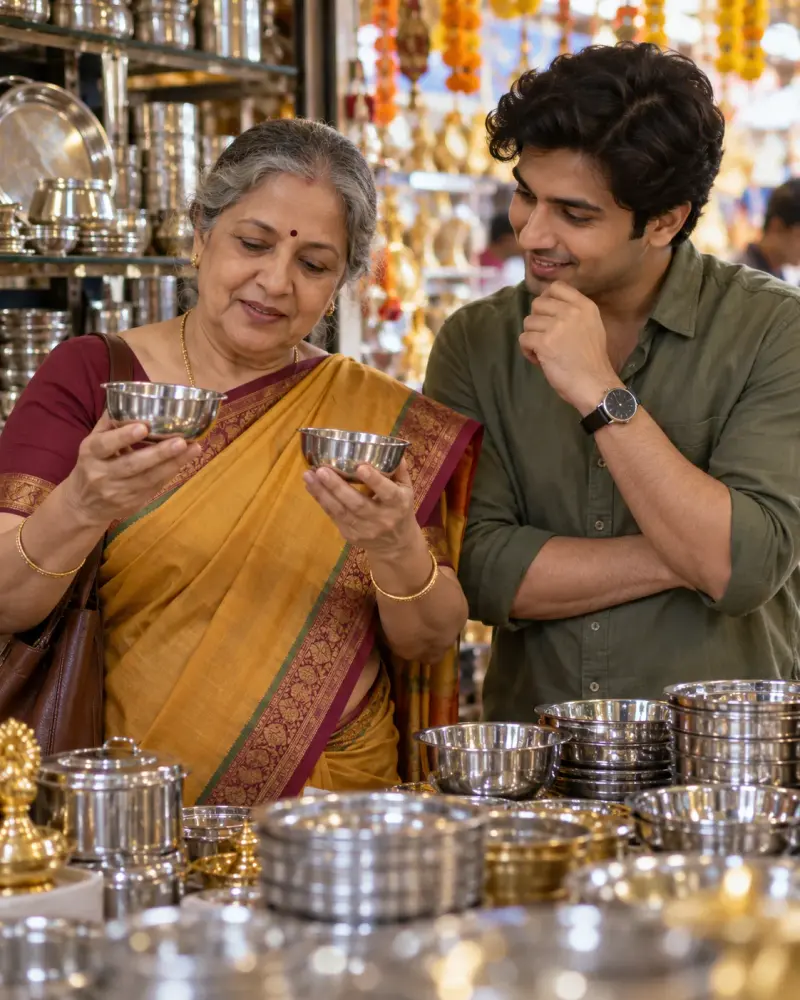
A family Dhanteras purchase memory card
A warm keepsake paragraph that preserves the actual memory and its uncertainties. Paste this prompt into ChatGPT, Gemini, Claude or Grok, change the parts in brackets to suit you, and generate.
- Written for
- ChatGPT, Gemini, Claude, Grok
- Occasion
- Dhanteras · 6 Nov
- Status
- Tested 9 Oct 2026 in Grok, 9 Oct 2026 (one run; model id not exposed)
- Test settings
- The page's exact default prompt was run once in Grok on 9 Oct 2026. The default details already written on the page were the input. They are illustrative, not a record of a real event. ChatGPT and Gemini were not used. The first result was kept.
- Variability
- A different set of details, or another run, will change the wording. This is the first result for the defaults on this page.
Prompt
Turn the supplied family memory into a short keepsake card. Keep person, object, place and date uncertainty as stated. Use one specific detail instead of generic prosperity promises. Offer a plain paragraph and a question to ask the family about missing information. Do not turn a remembered conversation into a verbatim quote.

My details:
Memory: grandmother chose a small steel bowl during a family market visit; I remember her comparing sizes. Year and shop name unknown. Tone: warm, about 100 words.

Use only supplied facts; fictional default details are examples, not a real event. Ask for essential missing input or mark unknowns rather than inventing people, prices, dates, permissions or commitments. Regional and family practices can differ; do not present one practice as a universal rule.

Aim for about 100 words in the keepsake paragraph unless a different length is supplied. Preserve the narrator's point of view, separate remembered detail from uncertainty, and avoid quoted dialogue without a supplied quotation. If the memory is too sparse, produce a shorter honest card instead of adding events or sensory details the narrator did not remember. Put the follow-up question outside the keepsake text.
Customise
Paste the real details. Leave out anything you do not want repeated.
Fields start with illustrative values; replace them with your own facts. The prompt updates as you type. Copy prompt copies your version.
Example output
Actual tested output. The notes used for this result are an example, not a real event. This box is not copied. Replace the notes above with your own before you paste the prompt.
Keepsake

My grandmother chose a small steel bowl during a family market visit. I remember her comparing sizes. The bowl in this memory is small, and it is steel. I do not remember the year. I do not remember the shop's name. I do not remember her exact words, so this card does not quote her and does not turn the size comparison into dialogue. What I can keep is only that scene: a family market visit, a small steel bowl, and her comparing sizes as I remember it. I have not added anything around it.

Question for the family, not part of the card

What else is actually remembered about that market visit, if anything, besides the small steel bowl and the size comparison? Please keep guesses separate from the memory, and do not turn the comparison into a quotation.
How to use it
- Open ChatGPT, Gemini, Grok or Claude.
- Paste the prompt and replace the [BRACKETS] with your details.
- Review names, facts and the requested format; follow up with corrections or missing details.
How to use this prompt
- Fill Customise with your real details. Do not let the tool guess a missing fact. Write the missing information clearly if you need to.
- Press Copy prompt and paste it into the AI app named above. This page copies the prompt. The answer is created in the external app.
- Check names, facts, numbers, language and the format you asked for. If something is wrong or incomplete, ask for a correction.
Good to know
- Review personal details and permission before sharing. Sparse memories may produce a shorter card; missing events, dates and dialogue must not be invented. Run once in Grok on 9 Oct 2026 using the illustrative defaults on this page. Check the draft against your own facts before you use it.
- Check facts before you rely on the answer.