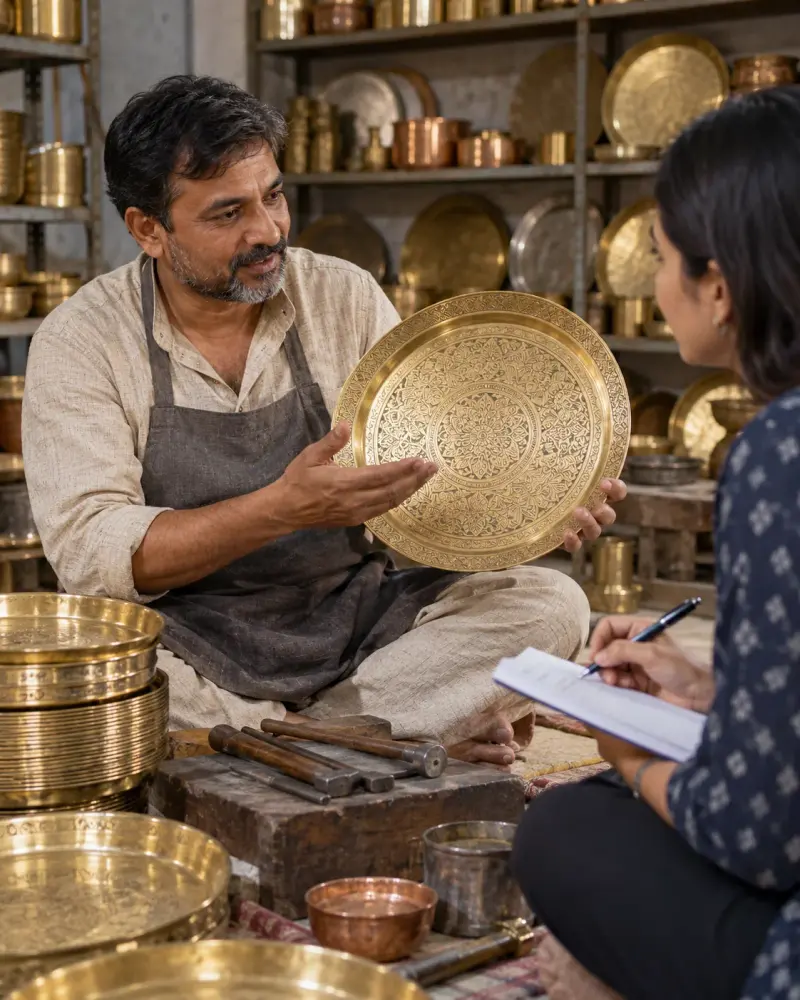
Interview questions for a Dhanteras artisan story
A maker interview plan and evidence-led story outline without fabricated quotes or heritage claims. Paste this prompt into ChatGPT, Gemini, Claude or Grok, change the parts in brackets to suit you, and generate.
- Written for
- ChatGPT, Gemini, Claude, Grok
- Occasion
- Dhanteras · 6 Nov
- Status
- Tested 9 Oct 2026 in Grok, 9 Oct 2026 (one run; model id not exposed)
- Test settings
- The page's exact default prompt was run once in Grok on 9 Oct 2026. The default details already written on the page were the input. They are illustrative, not a record of a real event. ChatGPT and Gemini were not used. The first result was kept.
- Variability
- A different set of details, or another run, will change the wording. This is the first result for the defaults on this page.
Prompt
Prepare interview questions and a story outline about the actual maker behind the supplied item. Separate verified facts from questions. Ask about process, materials, repairs and the maker’s own words without inventing a heritage lineage, location or hand-made claim. Add a consent question for quoting and photographs. No first-person quote should appear until I provide one.

My details:
Known: a local workshop supplied decorative metal trays. Unknown: who made them, process and material provenance. Desired story: 200 words for the shop website.

Use only supplied facts; fictional default details are examples, not a real event. Ask for essential missing input or mark unknowns rather than inventing people, prices, dates, permissions or commitments. Regional and family practices can differ; do not present one practice as a universal rule.

Provide a verified-facts list, six open questions, a consent/credit question and a story outline with clearly labelled gaps. A desired 200-word story is a target for a later fact-based draft, not permission to fill missing answers now. If no maker answers or permission are supplied, stop at questions/outline and identify what is needed before publication. Attribute only supplied words, with permission status marked separately; do not imply that an interview has happened.
Customise
Paste the real details. Leave out anything you do not want repeated.
Fields start with illustrative values; replace them with your own facts. The prompt updates as you type. Copy prompt copies your version.
Example output
Actual tested output. The notes used for this result are an example, not a real event. This box is not copied. Replace the notes above with your own before you paste the prompt.
No interview has happened. No maker answer and no permission were supplied, so this stops at questions and an outline. A 200-word website story is a later target, not a draft to fill in now.

Verified facts
- A local workshop supplied decorative metal trays.
- Intended later use, if a story is approved: about 200 words for the shop website.

Unknown
- Who made the trays.
- Process.
- Material provenance.
- Whether they are hand-made. That claim is not supplied and is not assumed.
- Workshop name, city, and any place more specific than "local".
- Any words from the maker.
- Permission to quote or to photograph.

Six open questions
1. Who made these decorative metal trays, and what credit line do you want if you agree to be named?
2. What steps do you use to make one tray?
3. What materials are used, and what do you know about where those materials come from?
4. What repairs are possible later, and what repairs are not possible?
5. Which of your own words, if any, may the shop print?
6. What should the shop leave out of a short website story?

Consent and credit question
May the shop quote your words, and may the shop take or publish photographs of you or of the trays? Please answer yes or no for quotes, and yes or no for photographs. You can agree to one and refuse the other. No quote will be written until you provide the words and permission. Credit will use only the name you approve.

Story outline with gaps (do not publish)
- Opening that can be supported now: a local workshop supplied decorative metal trays.
- Gap: maker's name and approved credit.
- Gap: process, in the maker's account.
- Gap: materials and provenance.
- Gap: what can and cannot be repaired.
- Gap: approved quotation. None is available. No first-person quote is invented.
- Gap: photograph permission.
- Length target after the gaps are filled: about 200 words. Do not write that story yet.

Needed before publication: the maker's answers, separate permission for quotes and for photographs, and the approved credit line.
How to use it
- Open ChatGPT, Gemini, Grok or Claude.
- Paste the prompt and replace the [BRACKETS] with your details.
- Review names, facts and the requested format; follow up with corrections or missing details.
How to use this prompt
- Fill Customise with your real details. Do not let the tool guess a missing fact. Write the missing information clearly if you need to.
- Press Copy prompt and paste it into the AI app named above. This page copies the prompt. The answer is created in the external app.
- Check names, facts, numbers, language and the format you asked for. If something is wrong or incomplete, ask for a correction.
Good to know
- Collect real answers and permission before drafting or publishing a maker story. Questions and an outline are not evidence that an interview happened. Run once in Grok on 9 Oct 2026 using the illustrative defaults on this page. Check the draft against your own facts before you use it.
- Check facts before you rely on the answer.