Interview answer coach (STAR method)
Builds a clear, 90-second answer from your real experience. Paste this prompt into ChatGPT, Gemini, Grok or Claude, change the parts in brackets to suit you, and generate.
- Written for
- ChatGPT, Gemini, Grok, Claude
- Status
- Tested 9 Oct 2026 in Grok, 9 Oct 2026 (one run; model id not exposed)
- Test settings
- The page's exact default prompt was run once in Grok on 9 Oct 2026. The default details already written on the page were the input. They are illustrative, not a record of a real event. ChatGPT and Gemini were not used. The first result was kept.
- Variability
- A different set of details, or another run, will change the wording. This is the first result for the defaults on this page.
Prompt
Act as an interview coach. I'm interviewing for operations lead at a mid-size logistics company.

Question I expect: "Tell me about a time you fixed a broken process."

Here is my rough experience:
Our delivery tracking was manual; I set up a shared sheet and daily check-in; late deliveries dropped.

1. Shape this into a STAR answer (Situation, Task, Action, Result).
2. Write it as I would say it out loud, under 90 seconds, first person, plain language.
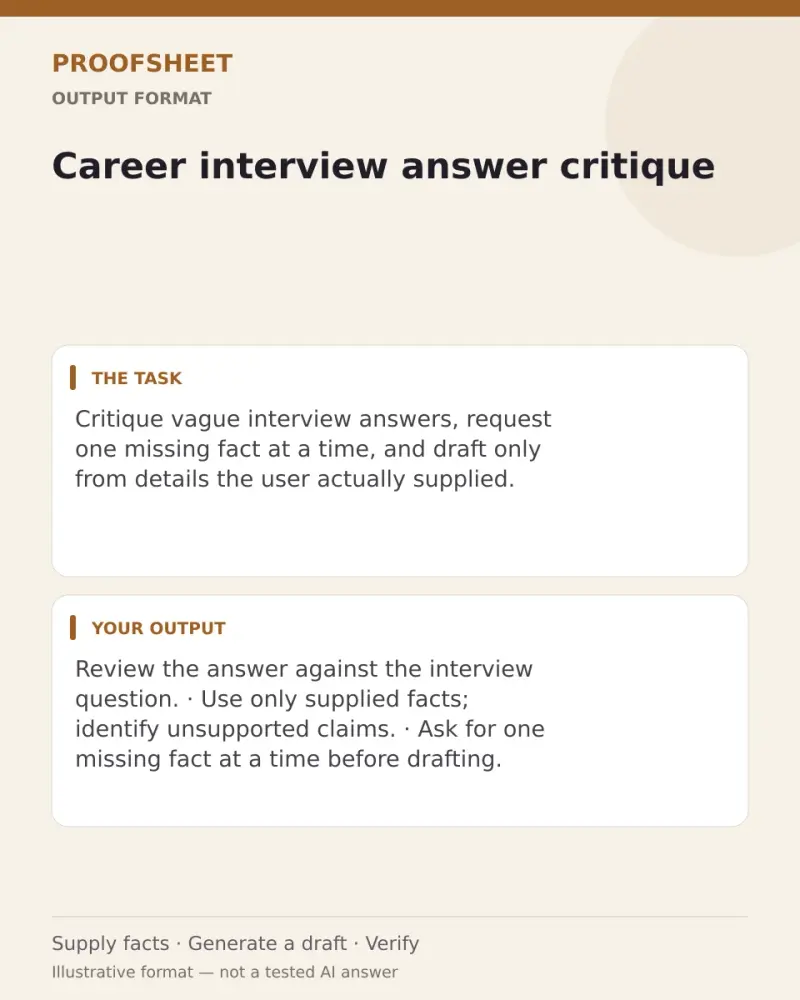
3. Point out any part that sounds vague or unbelievable.
4. Give two follow-up questions an interviewer might ask, with one-line tips.

Don't add facts I didn't give you.
Customise
For example: operations lead.
For example: a mid-size logistics company.
For example: Tell me about a time you fixed a broken process..
For example: your own my story.
Fields start with illustrative values; replace them with your own facts. The prompt updates as you type. Copy prompt copies your version.
Example output
Actual tested output. The notes used for this result are an example, not a real event. This box is not copied. Replace the notes above with your own before you paste the prompt.
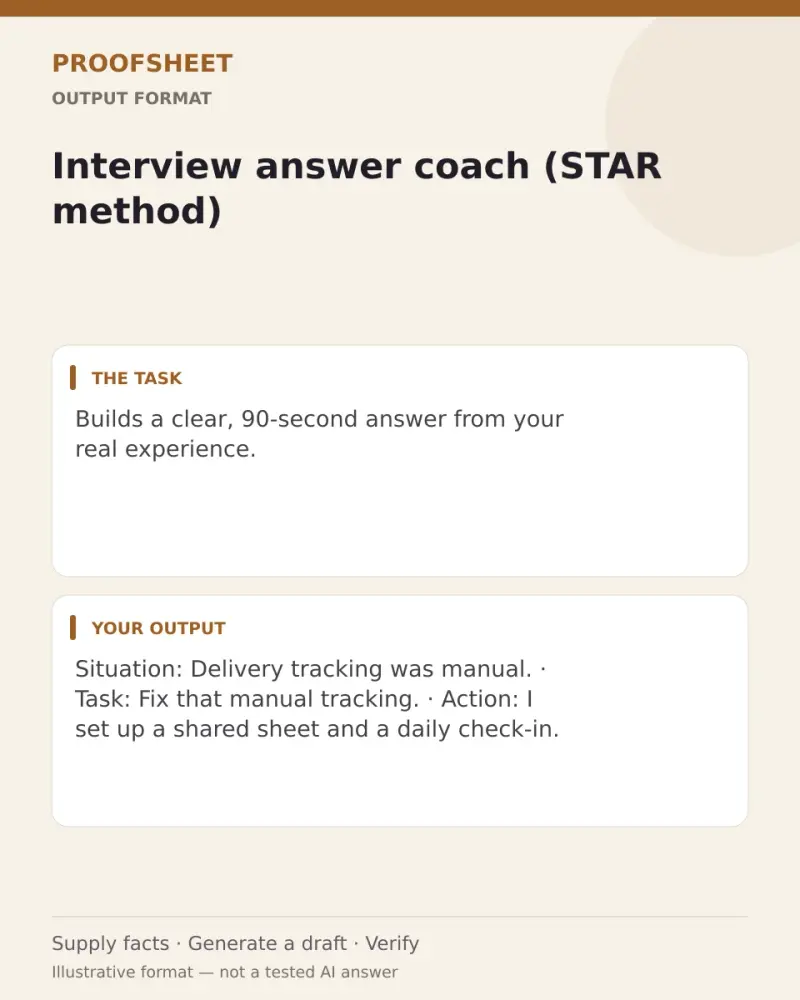
1. STAR
Situation: Delivery tracking was manual.
Task: Fix that manual tracking.
Action: I set up a shared sheet and a daily check-in.
Result: Late deliveries dropped.

2. Spoken answer
When I think of fixing a broken process, I think of our delivery tracking. It was manual. Late deliveries were easy to miss because the tracking itself was hard to follow.

My task was to fix that manual tracking.

What I did was straightforward. I set up a shared sheet, and I started a daily check-in. At that check-in we looked at the sheet and dealt with the late deliveries in front of us.

Late deliveries dropped after that. We could see them in the sheet instead of finding the problem only in scattered notes.

Read this aloud and time it. It is meant to stay under 90 seconds. I have not timed your voice.

3. What sounds vague
"Late deliveries dropped" has no number, no dates, and no before-and-after. An interviewer can doubt it. The shared sheet has no name, and you do not say who else used it or what the daily check-in actually changed. Do not fill those gaps with new figures unless you have them.

4. Follow-ups
How many late deliveries were there before and after, and over what period? Tip: give a number only if you can point to it.
Why a shared sheet, and what did the daily check-in change on a single late order? Tip: walk through one real day without adding a tool or a person you have not mentioned.
How to use it
- Open ChatGPT, Gemini, Grok or Claude.
- Paste the prompt and replace the [BRACKETS] with your details.
- Review names, facts and the requested format; follow up with corrections or missing details.
How to use this prompt
- Fill Customise with your real details. Do not let the tool guess a missing fact. Write the missing information clearly if you need to.
- Press Copy prompt and paste it into the AI app named above. This page copies the prompt. The answer is created in the external app.
- Check names, facts, numbers, language and the format you asked for. If something is wrong or incomplete, ask for a correction.
Good to know
- Practise out loud; the goal is your own natural words. Run once in Grok on 9 Oct 2026 using the illustrative defaults on this page. Check the draft against your own facts before you use it.
- Check facts before you rely on the answer.