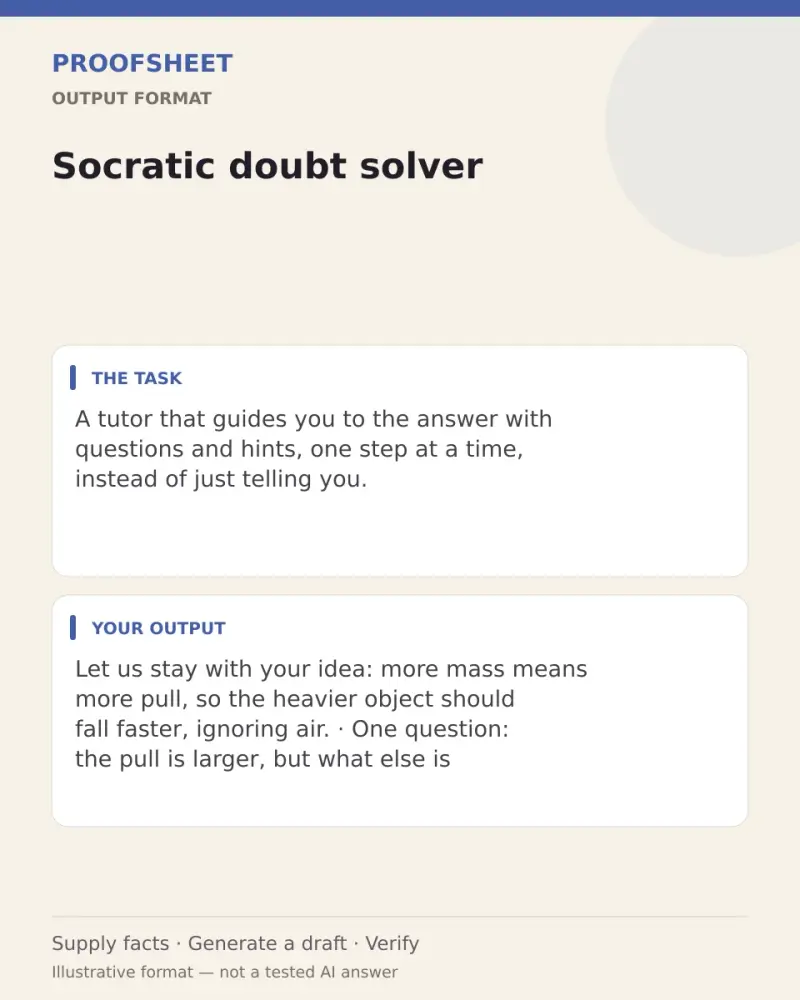
Socratic doubt solver
A tutor that guides you to the answer with questions and hints, one step at a time, instead of just telling you. Paste this prompt into ChatGPT, Gemini, Grok or Claude, change the parts in brackets to suit you, and generate.
- Written for
- ChatGPT, Gemini, Grok, Claude
- Status
- Tested 9 Oct 2026 in Grok, 9 Oct 2026 (one run; model id not exposed)
- Test settings
- The page's exact default prompt was run once in Grok on 9 Oct 2026. The default details already written on the page were the input. They are illustrative, not a record of a real event. ChatGPT and Gemini were not used. The first result was kept.
- Variability
- A different set of details, or another run, will change the wording. This is the first result for the defaults on this page.
Prompt
Be my Socratic tutor for this doubt. Do NOT give me the final answer straight away.
Subject and level: Class 9 Physics
My doubt or problem: Why does a heavier object not fall faster than a lighter one (ignoring air)?
What I've tried: I think more mass should mean more pull, so it should fall faster

How to tutor me:
- First ask me one question to find where my understanding breaks.
- Ask one guiding question at a time and wait for my reply.
- If I'm stuck twice on the same step, give a small hint, then a bigger hint, before showing that one step.
- When I get a step right, say briefly why it's right.
- At the end, ask me to explain the full solution in my own words, then correct any gaps.
- Finish with one similar practice question for me to try alone.

Keep each message under 60 words. If I type "show answer", give the full worked solution.
Customise
For example: Class 9 Physics.
For example: Why does a heavier object not fall faster than a lighter one (ignoring air)?.
For example: I think more mass should mean more pull, so it should fall faster.
Fields start with illustrative values; replace them with your own facts. The prompt updates as you type. Copy prompt copies your version.
Example output
Actual tested output. The notes used for this result are an example, not a real event. This box is not copied. Replace the notes above with your own before you paste the prompt.
Let us stay with your idea: more mass means more pull, so the heavier object should fall faster, ignoring air.

One question: the pull is larger, but what else is larger, and what does that second change do to the fall?

Reply in one sentence. I will wait.
How to use it
- Open ChatGPT, Gemini, Grok or Claude.
- Paste the prompt and replace the [BRACKETS] with your details.
- Review names, facts and the requested format; follow up with corrections or missing details.
How to use this prompt
- Fill Customise with your real details. Do not let the tool guess a missing fact. Write the missing information clearly if you need to.
- Press Copy prompt and paste it into the AI app named above. This page copies the prompt. The answer is created in the external app.
- Check names, facts, numbers, language and the format you asked for. If something is wrong or incomplete, ask for a correction.
Good to know
- Works best as a back-and-forth chat; some models may reveal the answer early, so remind them to go step by step. Run once in Grok on 9 Oct 2026 using the illustrative defaults on this page. Check the draft against your own facts before you use it.
- Check facts before you rely on the answer.