Grocery list optimiser to cut cost
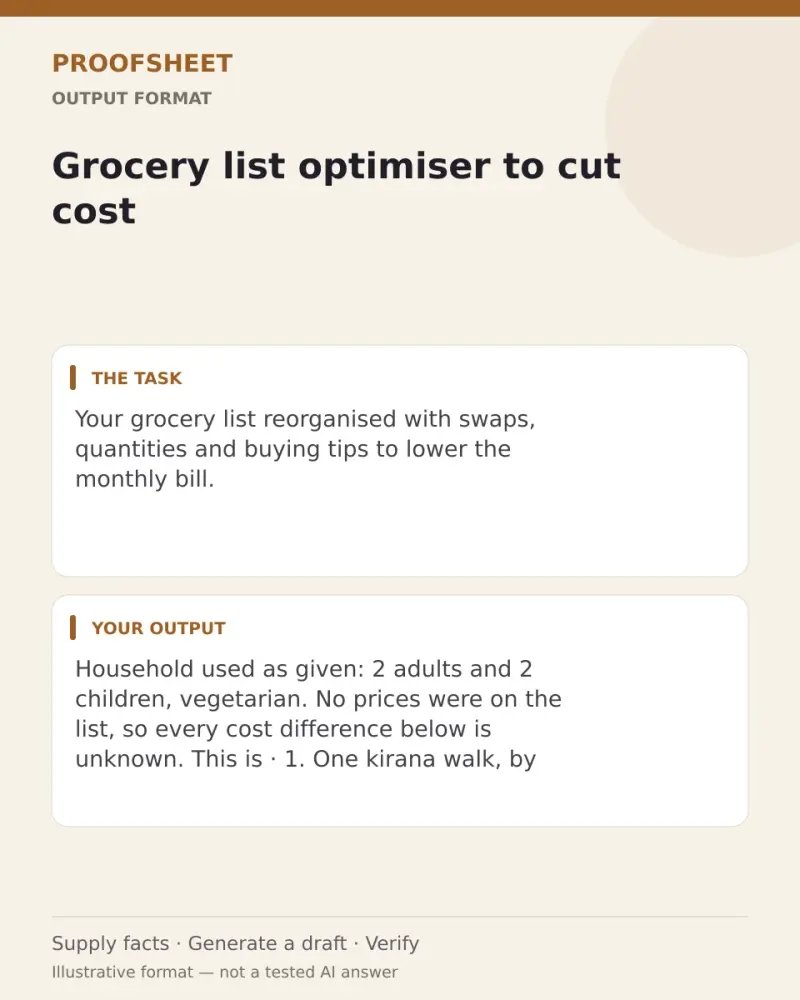
Your grocery list reorganised with swaps, quantities and buying tips to lower the monthly bill. Paste this prompt into ChatGPT, Gemini, Grok or Claude, change the parts in brackets to suit you, and generate.
- Written for
- ChatGPT, Gemini, Grok, Claude
- Status
- Tested 9 Oct 2026 in Grok, 9 Oct 2026 (one run; model id not exposed)
- Test settings
- The page's exact default prompt was run once in Grok on 9 Oct 2026. The default details already written on the page were the input. They are illustrative, not a record of a real event. ChatGPT and Gemini were not used. The first result was kept.
- Variability
- A different set of details, or another run, will change the wording. This is the first result for the defaults on this page.
Prompt
Help me cut the cost of my monthly groceries without eating worse.

Household: 2 adults and 2 children, vegetarian
My current list with quantities (and prices if I know them): atta 10 kg, rice 5 kg, toor dal 2 kg, milk 1 L daily, paneer 1 kg, cooking oil 3 L, biscuits 8 packs, juice 4 bottles, vegetables and fruits weekly
Where I usually buy: local kirana plus a quick-delivery app

Give me:
1. My list grouped by aisle or shop, so I buy in one trip.
2. Items to buy in bulk, items to buy weekly, and items likely to go to waste at my quantities.
3. Up to 8 proposed swaps to compare against supplied prices and the household’s preferences; do not assert nutritional equivalence (e.g. seasonal vegetables, store brands, loose vs packaged), each with one line on why.
4. A simple way to track spend next month.

Rules: Use only prices I gave; where I gave none, do not invent them — mark cost differences unknown and suggest comparing current unit prices at two shops or apps. Do not invent savings percentages or assert that a swap is cheaper without comparable supplied prices. If my household size or diet is unclear, ask first. This is general budgeting help, not diet or medical advice.

Offer a 7-day meal plan that uses this list.
Customise
For example: 2 adults and 2 children, vegetarian.
For example: your own grocery list.
For example: local kirana plus a quick-delivery app.
Fields start with illustrative values; replace them with your own facts. The prompt updates as you type. Copy prompt copies your version.
Example output
Actual tested output. The notes used for this result are an example, not a real event. This box is not copied. Replace the notes above with your own before you paste the prompt.
Household used as given: 2 adults and 2 children, vegetarian. No prices were on the list, so every cost difference below is unknown. This is budgeting help, not diet or medical advice.

1. One kirana walk, by group
- Staples: atta 10 kg, rice 5 kg, toor dal 2 kg
- Oil: cooking oil 3 L
- Dairy: milk for that day (1 L), paneer 1 kg
- Packaged: biscuits 8 packs, juice 4 bottles
- Produce: vegetables and fruit for the week (how much was not stated)

Use the quick-delivery app only for a line the kirana does not have that day. Compare the unit price, including any delivery fee shown, before you switch a line to the app. That fee was not supplied.

2. Bulk, weekly, and waste risk
- Bulk, if you have dry storage: atta 10 kg, rice 5 kg, toor dal 2 kg, cooking oil 3 L. These are the shelf-stable lines on your list. I am not saying this quantity is cheaper. Compare the price per kg or per litre.
- Weekly, or more often: vegetables and fruit, already weekly. Milk is 1 L a day, so buy it on the days you will use it, not as a month's stock. Paneer is perishable, so do not treat 1 kg as a bulk dry good.
- More likely to be wasted if bought too far ahead: milk past the day you need it, and paneer if 1 kg is not finished while it is still good. Vegetables and fruit can also spoil; the weekly amount was not given, so that risk is unknown. Biscuits (8 packs) and juice (4 bottles) are a waste risk only if they sit unused. I do not know if the household finishes them.

3. Swaps to compare, not claimed cheaper or nutritionally the same
- Loose atta against the packed atta you buy now. Compare price per kg at the kirana and on the app.
- Loose rice against packed rice, same comparison.
- Loose toor dal against a branded pack, same comparison.
- A larger oil tin against the 3 L you buy in smaller packs, only if that day's price per litre is lower. The difference is unknown until you check.
- Seasonal vegetables in place of the costliest vegetables that week. They are not the same food. Compare price per kg, and keep the household's preference.
- Some of the weekly fruit in place of part of the 4 juice bottles. Not the same product. Compare the bottle price with the fruit price.
- A kirana or store brand of biscuits against the 8 packs you buy now, if people in the house will eat them. Compare the pack price. Do not assume the same recipe.
- Paneer in smaller amounts through the month instead of 1 kg at once, if a kilogram is not finished in time. You might pay more per kg, or you might waste less. Both money figures are unknown until you compare.

4. Track next month
On one note, write the date, the shop or the app, and the amount for every grocery payment. At the end of the month, add those amounts. There is no baseline yet, because no prices were supplied. Do not invent a saving percent. Next month, compare that written total with the following month.

I can draft a 7-day vegetarian meal sketch that uses the atta, rice, toor dal, milk, paneer, oil and the weekly vegetables and fruit, with biscuits and juice left optional, if you want that next.
How to use it
- Open ChatGPT, Gemini, Grok or Claude.
- Paste the prompt and replace the [BRACKETS] with your details.
- Review names, facts and the requested format; follow up with corrections or missing details.
How to use this prompt
- Fill Customise with your real details. Do not let the tool guess a missing fact. Write the missing information clearly if you need to.
- Press Copy prompt and paste it into the AI app named above. This page copies the prompt. The answer is created in the external app.
- Check names, facts, numbers, language and the format you asked for. If something is wrong or incomplete, ask for a correction.
Good to know
- Savings depend on local prices and seasons, which the AI cannot see; treat its estimates as rough. Run once in Grok on 9 Oct 2026 using the illustrative defaults on this page. Check the draft against your own facts before you use it.
- Check facts before you rely on the answer.